
Think about the next state of affairs. A telephone rings. An workplace employee solutions it and hears his boss, in a panic, inform him that she forgot to switch cash to the brand new contractor earlier than she left for the day and desires him to do it. She offers him the wire switch info, and with the cash transferred, the disaster has been averted.
The employee sits again in his chair, takes a deep breath, and watches as his boss walks within the door. The voice on the opposite finish of the decision was not his boss. In truth, it wasn’t even a human. The voice he heard was that of an audio deepfake, a machine-generated audio pattern designed to sound precisely like his boss.
Assaults like this utilizing recorded audio have already occurred, and conversational audio deepfakes may not be far off.
Deepfakes, each audio and video, have been attainable solely with the event of subtle machine studying applied sciences in recent times. Deepfakes have introduced with them a brand new stage of uncertainty around digital media. To detect deepfakes, many researchers have turned to analyzing visible artifacts—minute glitches and inconsistencies—present in video deepfakes.
This isn’t Morgan Freeman, however in the event you weren’t informed that, how would you understand?
Audio deepfakes probably pose a fair higher menace, as a result of individuals usually talk verbally with out video—for instance, by way of telephone calls, radio, and voice recordings. These voice-only communications significantly broaden the chances for attackers to make use of deepfakes.
To detect audio deepfakes, we and our research colleagues on the College of Florida have developed a way that measures the acoustic and fluid dynamic differences between voice samples created organically by human audio system and people generated synthetically by computer systems.
Natural vs. artificial voices
People vocalize by forcing air over the varied buildings of the vocal tract, together with vocal folds, tongue, and lips. By rearranging these buildings, you alter the acoustical properties of your vocal tract, permitting you to create over 200 distinct sounds, or phonemes. Nonetheless, human anatomy essentially limits the acoustic conduct of those completely different phonemes, leading to a comparatively small vary of appropriate sounds for every.
How your vocal organs work.
In contrast, audio deepfakes are created by first permitting a pc to hearken to audio recordings of a focused sufferer speaker. Relying on the precise strategies used, the pc might need to listen to as little as 10 to 20 seconds of audio. This audio is used to extract key details about the distinctive facets of the sufferer’s voice.
The attacker selects a phrase for the deepfake to talk after which, utilizing a modified text-to-speech algorithm, generates an audio pattern that sounds just like the sufferer saying the chosen phrase. This course of of making a single deepfaked audio pattern could be completed in a matter of seconds, probably permitting attackers sufficient flexibility to make use of the deepfake voice in a dialog.
Detecting audio deepfakes
Step one in differentiating speech produced by people from speech generated by deepfakes is knowing easy methods to acoustically mannequin the vocal tract. Fortunately scientists have strategies to estimate what somebody—or some being akin to a dinosaur—would sound like primarily based on anatomical measurements of its vocal tract.
We did the reverse. By inverting many of those identical strategies, we have been in a position to extract an approximation of a speaker’s vocal tract throughout a phase of speech. This allowed us to successfully peer into the anatomy of the speaker who created the audio pattern.
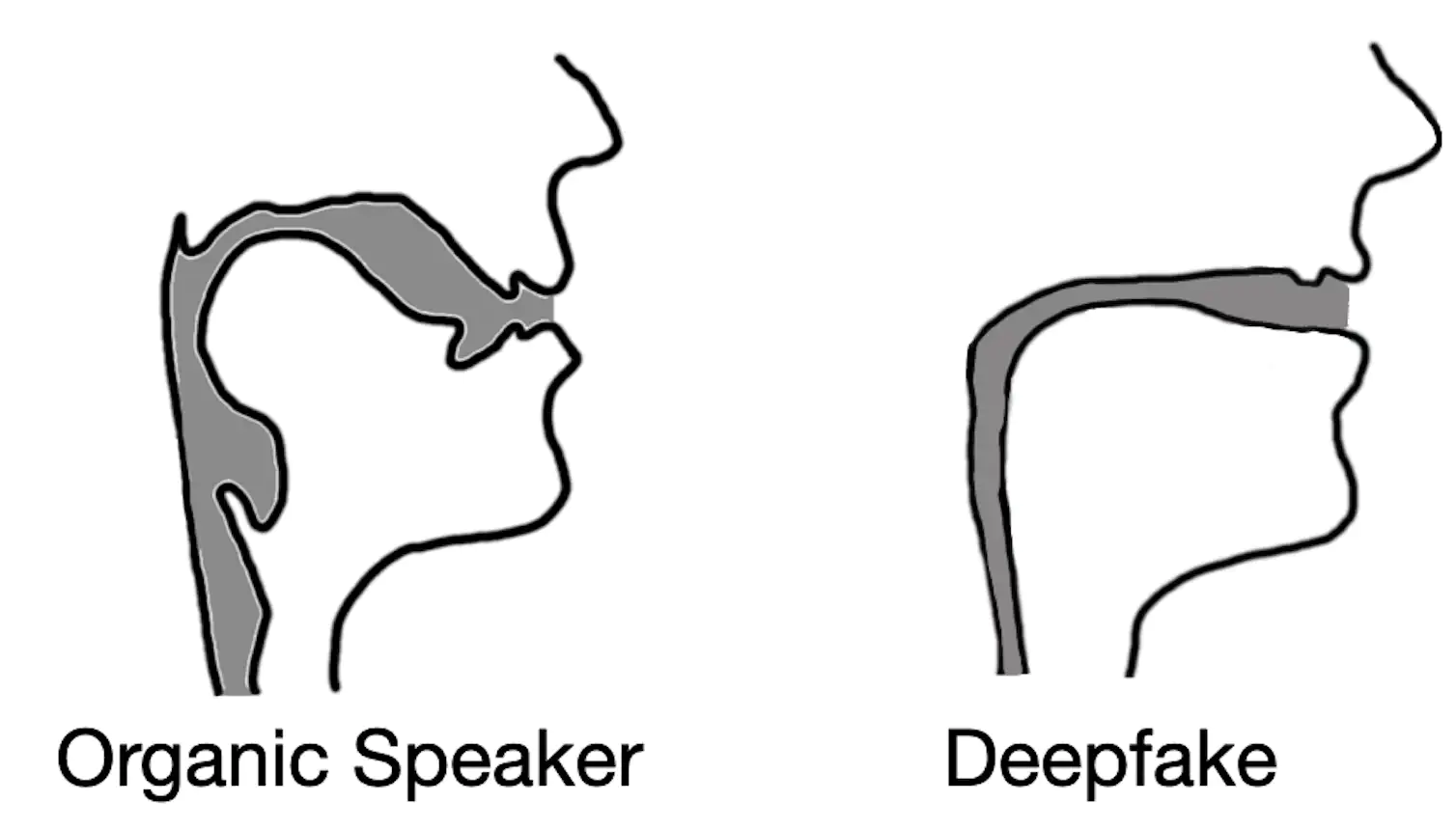
From right here, we hypothesized that deepfake audio samples would fail to be constrained by the identical anatomical limitations people have. In different phrases, the evaluation of deepfaked audio samples simulated vocal tract shapes that don’t exist in individuals.
Our testing outcomes not solely confirmed our speculation however revealed one thing attention-grabbing. When extracting vocal tract estimations from deepfake audio, we discovered that the estimations have been usually comically incorrect. For example, it was frequent for deepfake audio to lead to vocal tracts with the identical relative diameter and consistency as a consuming straw, in distinction to human vocal tracts, that are a lot wider and extra variable in form.
This realization demonstrates that deepfake audio, even when convincing to human listeners, is way from indistinguishable from human-generated speech. By estimating the anatomy chargeable for creating the noticed speech, it’s attainable to establish whether or not the audio was generated by an individual or a pc.
Why this issues
In the present day’s world is outlined by the digital alternate of media and data. The whole lot from information to leisure to conversations with family members sometimes occurs by way of digital exchanges. Even of their infancy, deepfake video and audio undermine the arrogance individuals have in these exchanges, successfully limiting their usefulness.
If the digital world is to stay a important useful resource for info in individuals’s lives, efficient and safe strategies for figuring out the supply of an audio pattern are essential.
Logan Blue is a PhD scholar in pc and data science and engineering on the University of Florida, and Patrick Traynor is professor of pc and data science and engineering on the University of Florida.
This text is republished from The Conversation underneath a Inventive Commons license. Learn the original article.