
Nvidia’s RTX 40-series graphics cards are arriving in just a few quick weeks, however amongst all of the {hardware} enhancements lies what could possibly be Nvidia’s golden egg: DLSS 3. It’s rather more than simply an replace to Nvidia’s standard DLSS (Deep Studying Tremendous Sampling) characteristic, and it might find yourself defining Nvidia’s next generation rather more than the graphics playing cards themselves.
AMD has been working laborious to get its FidelityFX Super Resolution (FSR) on par with DLSS, and for the previous a number of months, it’s been profitable. DLSS 3 seems like it can change that dynamic — and this time, FSR might not be capable of catch up anytime quickly.
How DLSS 3 works (and the way it doesn’t)
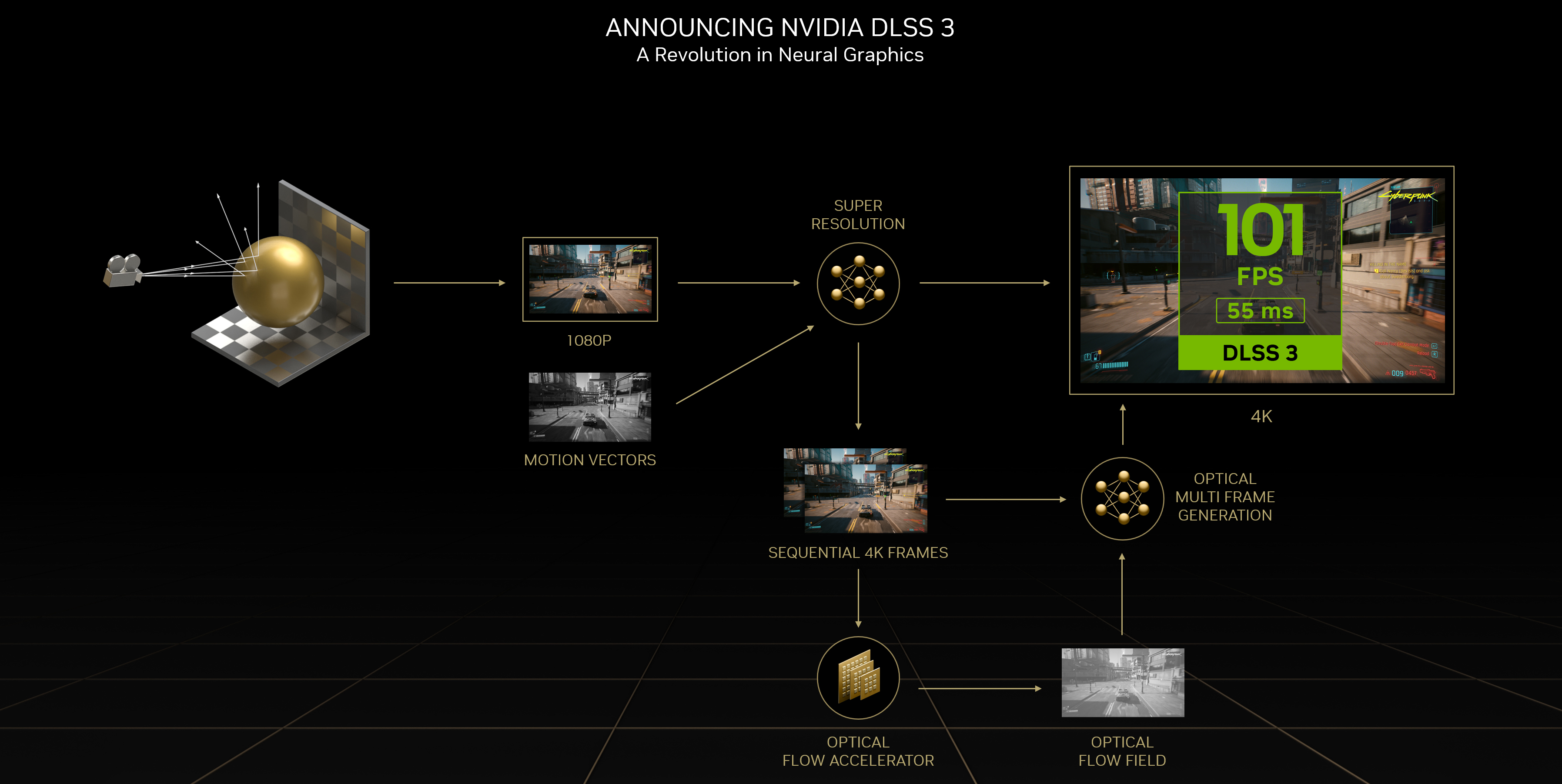
You’d be forgiven for considering that DLSS 3 is a very new model of DLSS, however it’s not. Or not less than, it’s not fully new. The spine of DLSS 3 is identical super-resolution know-how that’s accessible in DLSS titles in the present day, and Nvidia will presumably proceed enhancing it with new variations. Nvidia says you’ll see the super-resolution portion of DLSS 3 as a separate choice within the graphics settings now.
The brand new half is body technology. DLSS 3 will generate a wholly distinctive body each different body, primarily producing seven out of each eight pixels you see. You’ll be able to see an illustration of that within the circulation chart under. Within the case of 4K, your GPU solely renders the pixels for 1080p and makes use of that info for not solely the present body but in addition the subsequent body.
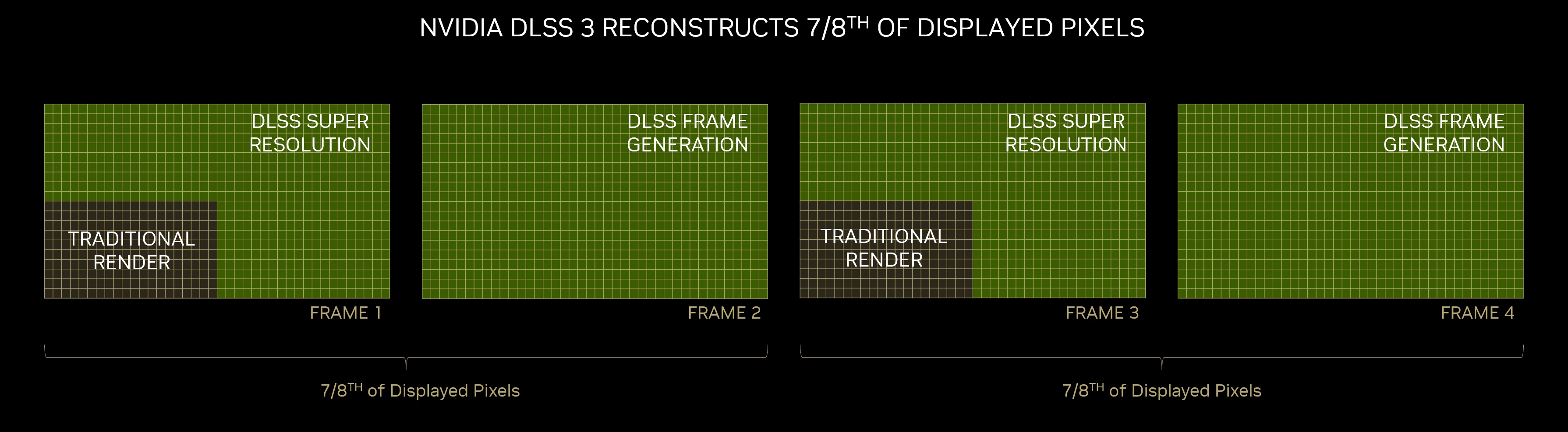
Body technology, in line with Nvidia, might be a separate toggle from tremendous decision. That’s as a result of body technology solely works on RTX 40-series GPUs for now, whereas the tremendous decision will proceed to work on all RTX graphics playing cards, even in video games which have up to date to DLSS 3. It ought to go with out saying, but when half of your frames are fully generated, that’s going to spice up your efficiency by quite a bit.
Body technology isn’t just a few AI secret sauce, although. In DLSS 2 and tools like FSR, movement vectors are a key enter for the upscaling. They describe the place objects are transferring from one body to the subsequent, however movement vectors solely apply to geometry in a scene. Components that don’t have 3D geometry, like shadows, reflections, and particles, have historically been masked out of the upscaling course of to keep away from visible artifacts.
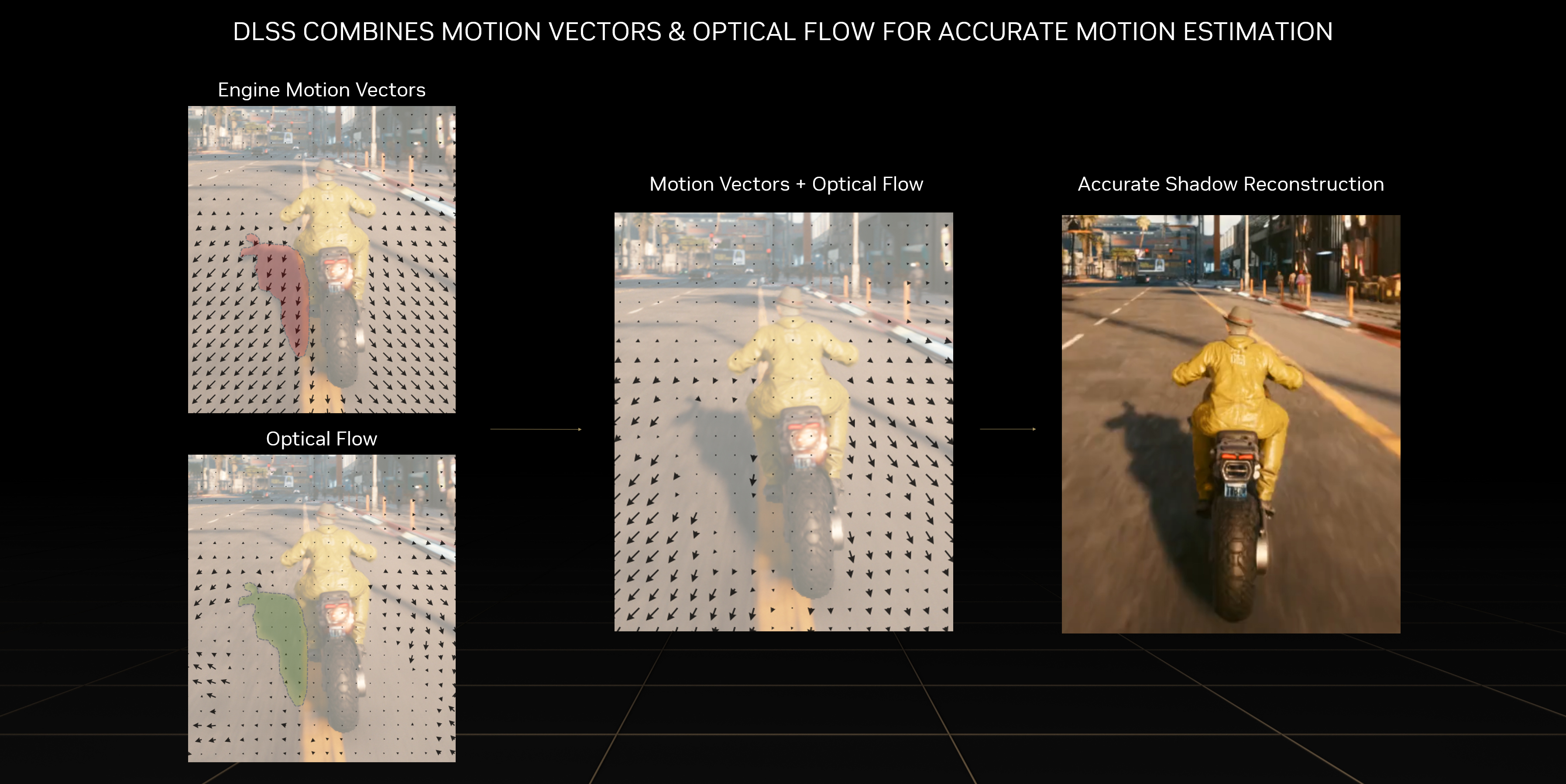
Masking isn’t an choice when an AI is producing a wholly distinctive body, which is the place the Optical Circulation Accelerator in RTX 40-series GPUs comes into play. It’s like a movement vector, besides the graphics card is monitoring the motion of particular person pixels from one body to the subsequent. This optical circulation area, together with movement vectors, depth, and coloration, contribute to the AI-generated body.
It feels like all upsides, however there’s an enormous drawback with frames generated by the AI: they enhance latency. The body generated by the AI by no means passes by your PC — it’s a “faux” body, so that you gained’t see it on conventional fps readouts in video games or instruments like FRAPS. So, latency doesn’t go down regardless of having so many additional frames, and as a result of computational overhead of optical circulation, the latency truly goes up. Due to that, DLSS 3 requires Nvidia Reflex to offset the upper latency.
Usually, your CPU shops up a render queue on your graphics card to ensure your GPU isn’t ready for work to do (that will trigger stutters and body fee drops). Reflex removes the render queue and syncs your GPU and CPU in order that as quickly as your CPU can ship directions, the GPU begins processing them. When utilized excessive of DLSS 3, Nvidia says Reflex can typically even end in a latency discount.
The place AI makes a distinction
AMD’s FSR 2.0 doesn’t use AI, and as I wrote about some time again, it proves you can get the same quality as DLSS with algorithms as a substitute of machine studying. DLSS 3 modifications that with its distinctive body technology capabilities, in addition to the introduction of optical circulation.
Optical circulation isn’t a brand new thought — it’s been round for many years and has purposes in the whole lot from video-editing purposes to self-driving automobiles. Nevertheless, calculating optical flow with machine learning is comparatively new as a result of a rise in datasets to coach AI fashions on. The explanation why you’d wish to use AI is easy: it produces fewer visible errors given sufficient coaching and it doesn’t have as a lot overhead at runtime.
DLSS is executing at runtime. It’s potential to develop an algorithm, freed from machine studying, to estimate how every pixel strikes from one body to the subsequent, however it’s computationally costly, which runs counter to the entire level of supersampling within the first place. With an AI mannequin that doesn’t require lots of horsepower and sufficient coaching information — and relaxation assured, Nvidia has loads of coaching information to work with — you possibly can obtain optical circulation that is top of the range and might execute at runtime.
That results in an enchancment in body fee even in video games which can be CPU restricted. Supersampling solely applies to your decision, which is sort of solely dependent in your GPU. With a brand new body that bypasses CPU processing, DLSS 3 can double body charges in video games even when you have an entire CPU bottleneck. That’s spectacular and at present solely potential with AI.
Why FSR 2.0 can’t catch up (for now)

AMD has actually performed the inconceivable with FSR 2.0. It seems improbable, and the truth that it’s brand-agnostic is even higher. I’ve been able to ditch DLSS for FSR 2.0 since I first noticed it in Deathloop. However as a lot as I get pleasure from FSR 2.0 and suppose it’s an incredible piece of equipment from AMD, it’s not going to catch as much as DLSS 3 any time quickly.
For starters, growing an algorithm that may monitor every pixel between frames freed from artifacts is hard sufficient, particularly in a 3D setting with dense high quality element (Cyberpunk 2077 is a major instance). It’s potential, however robust. The larger difficulty, nonetheless, is how bloated that algorithm would should be. Monitoring every pixel by 3D house, doing the optical circulation calculation, producing a body, and cleansing up any mishaps that occur alongside the way in which — it’s quite a bit to ask.
Getting that to run whereas a recreation is executing and nonetheless offering a body fee enchancment on the extent of FSR 2.0 or DLSS, that’s much more to ask. Nvidia, even with devoted processors and a skilled mannequin, nonetheless has to make use of Reflex to offset the upper latency imposed by optical circulation. With out that {hardware} or software program, FSR would possible commerce an excessive amount of latency to generate frames.
I’ve little question that AMD and different builders will get there ultimately — or discover one other manner round the issue — however that could possibly be just a few years down the street. It’s laborious to say proper now.
What’s straightforward to say is that DLSS 3 seems very thrilling. After all, we’ll have to attend till it’s right here to validate Nvidia’s efficiency claims and see how picture high quality holds up. To date, we simply have a brief video from Digital Foundry exhibiting off DLSS 3 footage (above), which I’d extremely advocate watching till we see additional third-party testing. From our present vantage level, although, DLSS 3 actually seems promising.
This text is a part of ReSpec – an ongoing biweekly column that features discussions, recommendation, and in-depth reporting on the tech behind PC gaming.
Editors’ Suggestions